
Threat Intelligence · 4 min read
World Password Day: Why Strong Passwords Are Not Enough
World Password Day: Why Strong Passwords Are Not Enough Passwords are still the first line of defense. But most modern attacks do not try to “break” them. They simply use them. For years, organizations focused heavily on password complexity policies. Minimum…
Pavlina Nikolova ·

Passwords are still the first line of defense. But most modern attacks do not try to “break” them. They simply use them.
For years, organizations focused heavily on password complexity policies. Minimum length. Uppercase letters. Numbers. Special characters. Regular password rotation.
These measures still matter. But the reality of modern attacks looks very different.
In most incidents today, attackers do not gain access through brute force attacks. They use compromised credentials, phishing campaigns, reused passwords, or stolen sessions.
In other words:
This changes how organizations should think about identity protection.
“Attackers increasingly log in with valid access instead of breaking into systems from the outside.”
What Real Attacks Look Like Today
In practice, we consistently see the same sequence:
The issue is not necessarily a weak password.
The issue is lack of visibility into identity activity and delayed response.
- an employee receives a convincing phishing email;
- credentials are entered;
- MFA (Multi-Factor Authentication) is bypassed through session hijacking or MFA fatigue;
- the attacker logs in with a legitimate account;
- activity appears “normal”;
- nobody reacts quickly enough.
Where Traditional Password Policies Fail
Many organizations still rely primarily on:
But this is often insufficient when:
A strong password reduces risk. But it does not provide control over what happens after a successful login.
- mandatory password rotation;
- complexity requirements;
- periodic awareness training;
- basic MFA deployment.
- login activity is not monitored;
- anomalies are not analyzed;
- visibility remains fragmented;
- there is no clear response process;
- identity events never reach the SOC team.
What Actually Reduces Risk
Organizations should treat identity security as an operational process, not a one-time configuration.
In practice, this includes:
Security does not depend only on password complexity. It depends on whether organizations can see, understand, and control access activity in real time.
- MFA across all critical systems;
- conditional access policies;
- login anomaly monitoring;
- impossible travel detection;
- session monitoring and session revocation;
- centralized SIEM/XDR visibility;
- 24/7 response to suspicious identity activity.
How to Create a Strong but Memorable Password
One of the most common problems is that highly complex passwords are difficult to remember. As a result, users often:
A better approach is using a memorable but unique passphrase.
- reuse passwords across services;
- write passwords down;
- make only minimal changes during password rotations.
Example approach
Create a sentence or phrase that is meaningful to you but not publicly known.
For example:
Then:
Example:
This creates:
““My dog loves the sea in July””
- replace letters with symbols or numbers;
- combine uppercase and lowercase letters;
- add unique elements.
- a long password;
- resistance against automated guessing;
- better memorability compared to random strings.
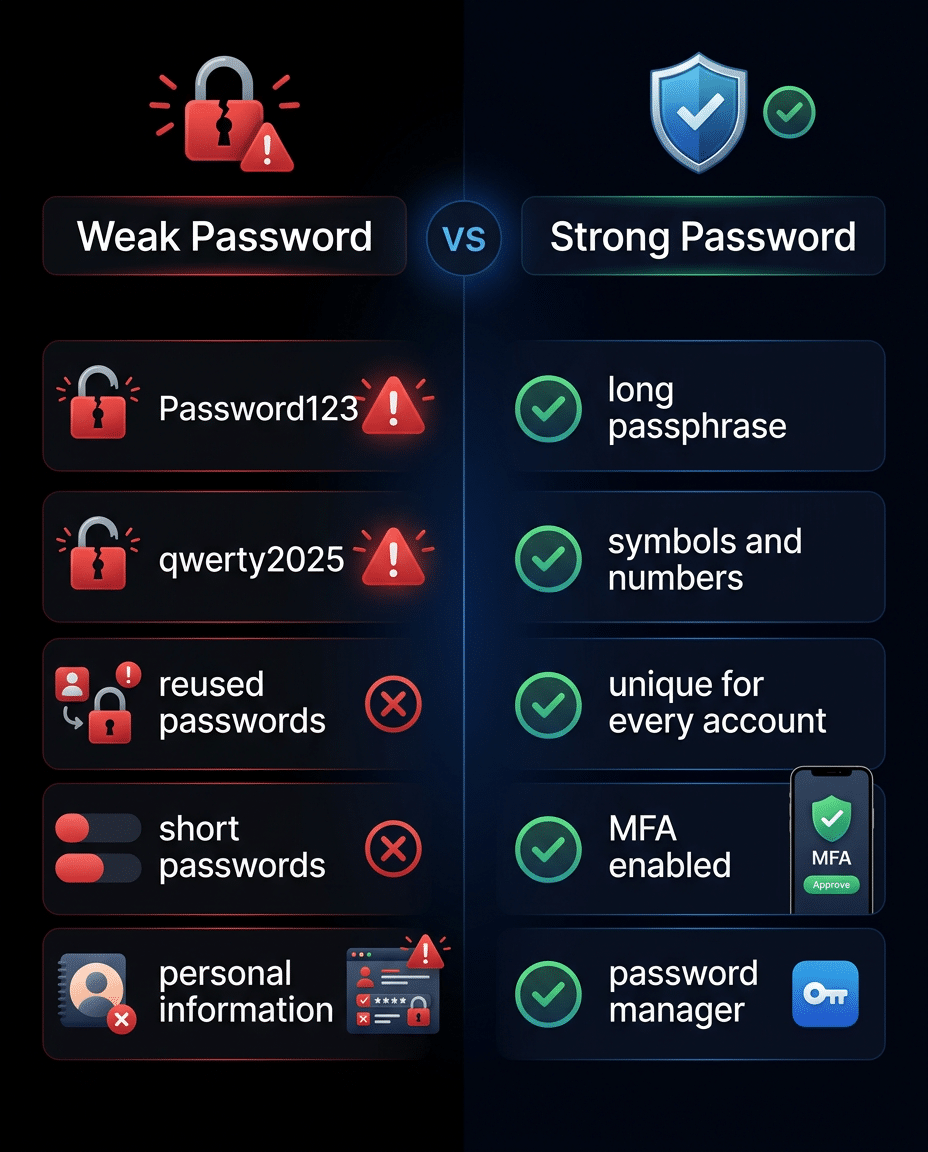
What a Strong Password Looks Like
- at least 14–16 characters;
- unique for every account;
- combination of uppercase and lowercase letters;
- includes numbers and symbols;
- avoids personal information;
- avoids common phrases or dictionary words;
- combined with MFA;
- supported by a password manager whenever possible.
What Comes Next: Quantum Computing, Passwordless Security, and the Future of Identity
Most attacks today rely on stolen credentials, phishing, and compromised sessions. At the same time, another long-term challenge is gradually approaching. Quantum computing.
While large-scale practical attacks against modern encryption are not yet a reality, organizations are already preparing for post-quantum security models. The reason is straightforward. Some cryptographic mechanisms used today, including technologies related to authentication and data protection, may become vulnerable once sufficiently powerful quantum systems emerge.
This does not mean that all passwords will suddenly become compromised overnight. But it does mean that identity security is gradually moving beyond traditional password-centric protection.
We are already seeing this shift through:
Instead of relying only on a single login event, the future of identity security is increasingly based on continuous evaluation of user behavior and risk context.
- passwordless authentication;
- biometric access;
- hardware security keys;
- adaptive authentication;
- contextual access policies;
- continuous identity verification.
MFA and NIS2 Requirements
Many organizations still treat MFA (Multi-Factor Authentication) as an optional security layer. In practice, it is increasingly becoming a baseline requirement.
Frameworks such as NIS2 place strong emphasis on:
In real environments, MFA significantly reduces the risk of account compromise through:
However, MFA alone is insufficient when:
This is why identity protection is no longer just an IT configuration task. It is becoming part of the organization’s operational cybersecurity model.
- access management;
- identity protection;
- prevention of unauthorized access;
- operational resilience.
- phishing;
- credential stuffing;
- password reuse;
- leaked credentials.
- identity events are not monitored;
- anomalies are not investigated;
- active sessions and access activity remain invisible.
The DIAMATIX Perspective
In real environments, the issue is rarely just technology.
Organizations often already have:
But identity activity remains fragmented and insufficiently monitored.
This is where incidents remain unnoticed long enough to become operational problems.
Modern identity protection requires:
Because security does not end at login. It starts there.
- password policies;
- MFA;
- protected endpoints;
- email security.
- visibility;
- correlation;
- context;
- response.
Conclusion
Passwords remain important. But on their own, they cannot provide sufficient protection against modern attacks.
Today, risk increasingly comes from:
Organizations must move beyond password complexity and build operational control over identity activity and access management.
On World Password Day, the focus should not only be on how strong a password is.
The focus should be on who is using access, when, and whether the organization has visibility and response capabilities in real time.
Contact DIAMATIX
Trusted · Innovative · Vigilant.
- compromised credentials;
- lack of visibility;
- delayed response;
- uncontrolled identity activity.